
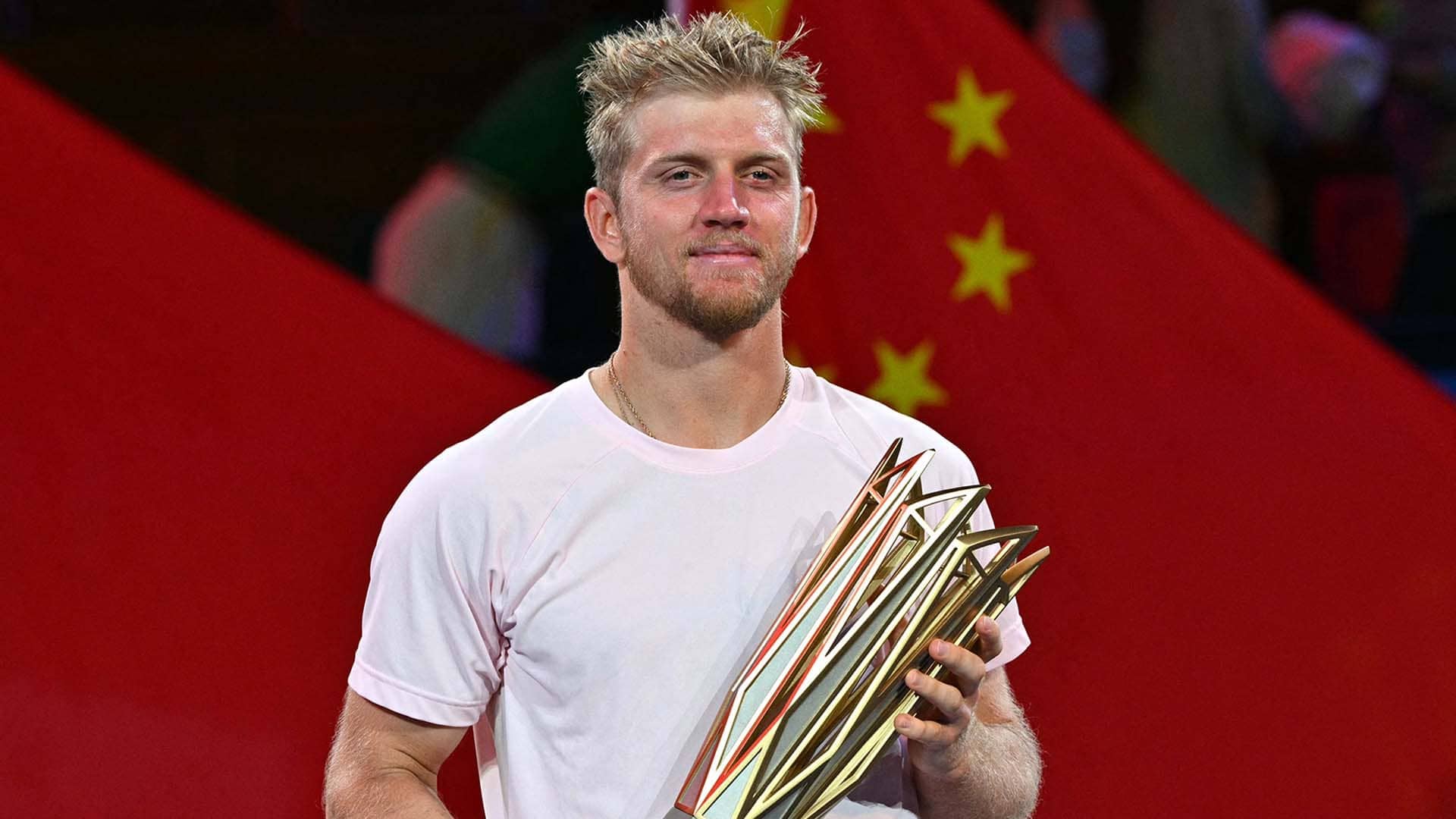
An all-Spanish final became a story of changing fortunes, as Alejandro Davidovich Fokina fought back against Rafael Jódar to claim his first ATP Masters 1000 title.
Tennis can be wonderfully deceptive. An opening set can suggest certainty. A scoreboard can make a championship feel almost within reach. Yet somewhere between the apparent ending and the final point, a match can discover an entirely different life.
On Sunday, 18 October, Alejandro Davidovich Fokina gave the Shanghai Masters final precisely that transformation.
The Spaniard defeated compatriot Rafael Jódar 1–6, 7–6(5), 6–4, securing the biggest title of his career through a comeback that demanded patience as much as courage. For Davidovich Fokina, Shanghai became the setting for a first Masters 1000 triumph. For Jódar, it was a painful finish to a remarkable run.
An Opening Written by Jódar
The first set belonged emphatically to Jódar.
At 20, and contesting his first Masters 1000 final, the younger Spaniard established an early advantage that the 6–1 scoreline made unmistakable. He had arrived at the occasion with an opportunity to turn a breakthrough tournament into something greater still.
There is a particular fascination in watching a young contender approach a major title. Every game seems to carry two stories: the match being played and the career beginning to take shape around it.
For Davidovich Fokina, the immediate task was more modest. He needed to find a foothold before the final slipped further away.
The Set That Changed the Story
Jódar also moved a break ahead in the second set. Davidovich Fokina recovered that deficit, survived further pressure on his serve and brought the contest to a tie-break.
This was where the final acquired its tension.
A lead offers something precious, but it also creates something to protect. For the player pursuing it, each escape can become a small source of belief. The distance between the two begins to feel less secure.
Davidovich Fokina took the tie-break 7–5. A match that had seemed to be moving firmly towards Jódar was level at one set apiece.
The championship now required a third set, and both men had to begin again with everything still available.
A Trophy Earned Through Persistence
Davidovich Fokina completed the turnaround by winning the deciding set 6–4. The final lasted approximately two hours and 27 minutes, a considerable journey from its one-sided opening.
What makes this victory compelling is the shape of it.
A player can spend the opening stages searching for answers and still finish with the trophy. That possibility is one of tennis’s enduring attractions. There is time to adjust, provided you can keep yourself close enough to use it.
Davidovich Fokina did.
His first Masters 1000 title arrived four years after his appearance in the Monte Carlo final in 2022. Shanghai gave that earlier achievement a new companion, and his career a significant new distinction.
Jódar Leaves With More Than a Defeat
For Jódar, the disappointment will be inseparable from the opportunities he created.
He became the youngest men’s singles finalist in Shanghai Masters history. His route to Sunday included a straight-sets victory over former world No. 1 Daniil Medvedev in the semi-finals, establishing that his place in the championship match had been thoroughly earned.
A runner-up finish can feel especially severe when the title has been within reach. The immediate memory is likely to settle on the chances that escaped.
The wider view deserves room too.
Jódar reached a Masters 1000 final, commanded its opening set and pushed the eventual champion into a deciding one. Those are substantial achievements for a player at this stage of his career.
His next challenge will be to carry the value of this week forward while learning from its final afternoon.
Shanghai’s Lasting Impression
The final offered two different kinds of arrival: a young player demonstrating how far he could go, and an established contender discovering how much he could withstand.
Davidovich Fokina leaves Shanghai with the trophy. Jódar leaves with evidence of his growing possibilities.
And the match leaves behind a familiar reason to love this sport: the extraordinary space that can exist between a difficult beginning and a triumphant finish.

Author: swoosh0018
Explore • Eat • Travel • Discover Football & Sports Obcessed South Africa | Worldwide 🌎 Living Life Beyond the Ordinary Blog Thats Simply Sublimevel