
The Springboks produced the response South Africa needed in Cape Town on 29 August, beating New Zealand 33–26 at DHL Stadium to level the four-Test series 1–1.
It was much closer to classic Springbok Test rugby: physicality, set-piece pressure, breakdown aggression and relentless scoreboard pressure. But the seven-point margin also tells an important story—the Boks fixed several problems from Johannesburg without completely solving the threat posed by New Zealand’s attack.
The biggest change was South Africa imposed themselves early and started strong.After the 33–16 defeat in Johannesburg, the Boks couldn’t afford another passive opening.
They got exactly the opposite. Within two minutes, South Africa used a powerful lineout maul to establish field position before moving the ball through the backs, with Jesse Kriel powering over for the opening try.
That early score mattered beyond the seven points. South Africa were suddenly dictating the terms of the contest rather than responding to New Zealand. The All Blacks responded beautifully. Will Jordan broke through on the right and released Cam Roigard, whose try levelled the match.
That became the pattern of the first half: South Africa would establish control, and New Zealand’s speed and skill would threaten to rip that control away. De Allende and Kriel gave the Boks directness with South Africa’s midfield proving to be hugely influential.
Damian de Allende scored the second Bok try after a strong Sacha Feinberg-Mngomezulu carry, while Kriel’s opening score gave both centres tries inside the opening quarter.
The combination gave South Africa something they badly needed: gain-line dominance in the middle of the field.
Instead of allowing New Zealand’s defence to dictate where the ball went, the Boks repeatedly challenged them physically before looking wider.
But there was a warning attached. New Zealand found ways around South Africa’s aggressive defence, particularly in the wider channels. Their second try, finished by Damian McKenzie, demonstrated how dangerous the All Blacks could be once they got beyond the initial Bok defensive pressure.
That remains one of the areas Rassie Erasmus will want corrected before Test three.
Siya Kolisi changed the feel of the Bok pack and Kolisi’s return was Massive.
Not simply because he scored. His work around the breakdown helped South Africa secure cleaner attacking possession, while his physicality gave the Bok back row considerably more authority.
Then came the crucial moment shortly before half-time. Rassie had already introduced Malcolm Marx and Ox Nché unusually early, around the 35-minute mark. The refreshed front row immediately helped South Africa win a scrum penalty inside the New Zealand 22. The Boks turned that pressure into points, with Kolisi burrowing over for the third try.
South Africa went into half-time 24–14 ahead.
That sequence was probably the tactical moment of the match. Normally South Africa’s replacement forwards are associated with second-half destruction. This time Erasmus effectively deployed part of his Bomb Squad before half-time.
It worked.Pieter-Steph’s 100th was appropriately brutal,This was also Pieter-Steph du Toit’s 100th Test.
And his performance was exactly what you’d expect from him in a milestone match: enormous work rate, collisions, defensive pressure and 80 minutes of effort. When Kolisi departed during the second half, Du Toit also assumed the captaincy.
Afterwards he reflected on beginning his international journey at Newlands and reaching 100 Tests at Cape Town Stadium with his family present. For one of the defining players of this Springbok era, it was a fitting occasion.
Cheslin Kolbe was the difference. The official man of the match was Cheslin Kolbe, and it’s difficult to argue with it.
His kicking numbers:
3 conversions.
4 penalties.
7 kicks attempted.
7 successful.
18 points.
That’s where the scoreline becomes interesting.New Zealand actually outscored South Africa four tries to three.
But Kolbe punished virtually every opportunity the All Blacks gave him. After half-time, South Africa became noticeably more pragmatic.
Instead of constantly hunting the knockout try, the Boks accepted the points available to them. Kolbe landed two penalties early in the second half and suddenly the lead had expanded from ten points to 30–14.
That is elite Test-match management. New Zealand now needed more than two converted tries just to get back in front.
Where the Boks won it: set piece and breakdown
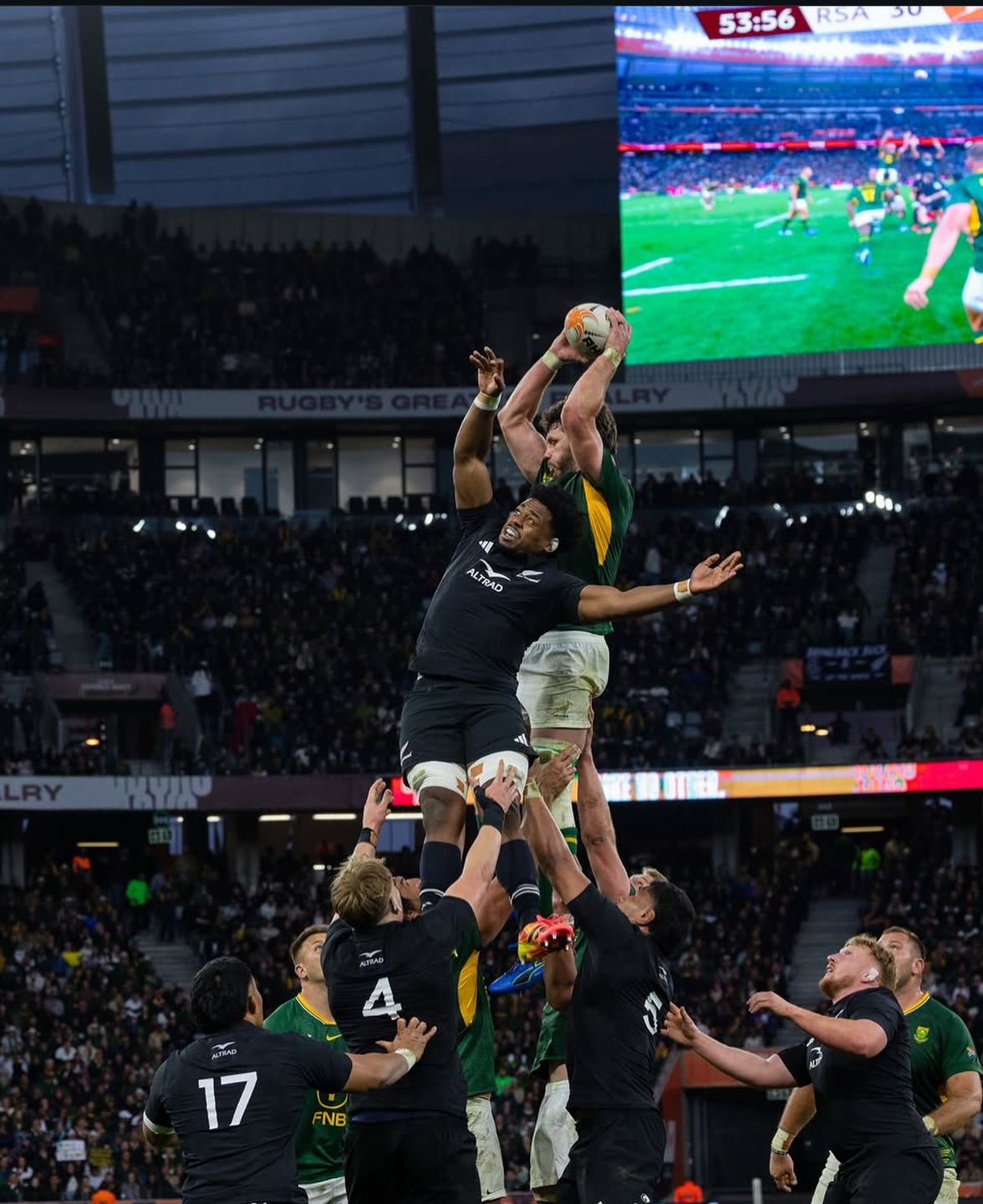
The glamorous moments came from the backs, but South Africa’s forwards provided the foundation. The lineout battle was particularly significant. Eben Etzebeth, Lood de Jager and Ruan Nortje repeatedly pressured New Zealand’s possession, disrupting or stealing important All Black lineout ball.
South Africa were also much stronger around the contact area than in the first Test. That combination meant New Zealand couldn’t consistently generate the clean possession required to unleash Jordan, McKenzie and their other dangerous runners.
The Boks weren’t simply bigger. They were more accurate about where they applied their physicality.
But the All Blacks exposed a real weakness. This wasn’t a comprehensive Springbok performance.
New Zealand scored four tries. That should concern Erasmus.
When the All Blacks got quick possession and moved the ball beyond South Africa’s initial defensive pressure, they looked extremely dangerous. Erasmus himself highlighted their width, offloading and ability to beat defenders afterwards, saying South Africa still had areas to fix.
And New Zealand never disappeared. Leroy Carter scored to reduce the deficit before Ardie Savea powered over late.
Suddenly it was 33–26. Then Lood de Jager received a yellow card with less than a minute remaining.New Zealand attacked again looking for the converted try that could have made it 33–33.
South Africa finally secured the decisive turnover inside their own 22.
So while the Boks deserved the victory, this wasn’t a case of South Africa grinding New Zealand into submission.
The All Blacks were alive until the final possession.
What should worry South Africa?
There are two obvious issues. First, the edge defence. New Zealand repeatedly demonstrated that if they survive the Bok pressure and get the ball wide quickly, there are opportunities.
Second, South Africa weren’t able to completely close the game. At 30–14, the Boks had an opportunity to suffocate New Zealand. Instead, the All Blacks fought their way back to 33–26 and were attacking for a potential equaliser at the end. Against this New Zealand team, a 16-point advantage isn’t necessarily safe.
Erasmus recognised that afterwards, warning that the Boks shouldn’t interpret victory as evidence that everything had been fixed.
What should worry New Zealand?
The All Blacks’ attacking rugby is genuinely dangerous. But against South Africa, set-piece instability and indiscipline are incredibly expensive. Ardie Savea essentially acknowledged that afterwards: New Zealand allowed South Africa to establish an early advantage and then spent too much of the contest chasing them.
Four tries would win plenty of Tests. It didn’t win this one because South Africa converted pressure into points much more efficiently.
Boks rediscovered their identity — but this rivalry is beautifully balanced
The most encouraging thing for South Africa wasn’t simply winning 33–26. It was the manner in which they responded to Johannesburg.
They restored their physical edge. Kolisi’s return improved the breakdown. Erasmus successfully manipulated his front-row replacements. The lineout put New Zealand under pressure. And Kolbe turned virtually every All Black infringement into points.
But New Zealand scoring four tries is why this series feels far from settled. Erasmus described this as a significantly improved All Blacks side and warned that South Africa would have to get better again. That’s the right reading.
Cape Town belonged to the Boks. But tactically, New Zealand showed enough to make Test three at FNB Stadium extremely interesting.

Author: swoosh0018
"Im Swoosh. Seeking the extraordinary in every corner & Exploring South Africa in Style" Football,Sports,Lifestyle,Food & Travel